AI Should Move the Metric, Not Just Impress the Team | AI For Business Northern Ireland, Belfast
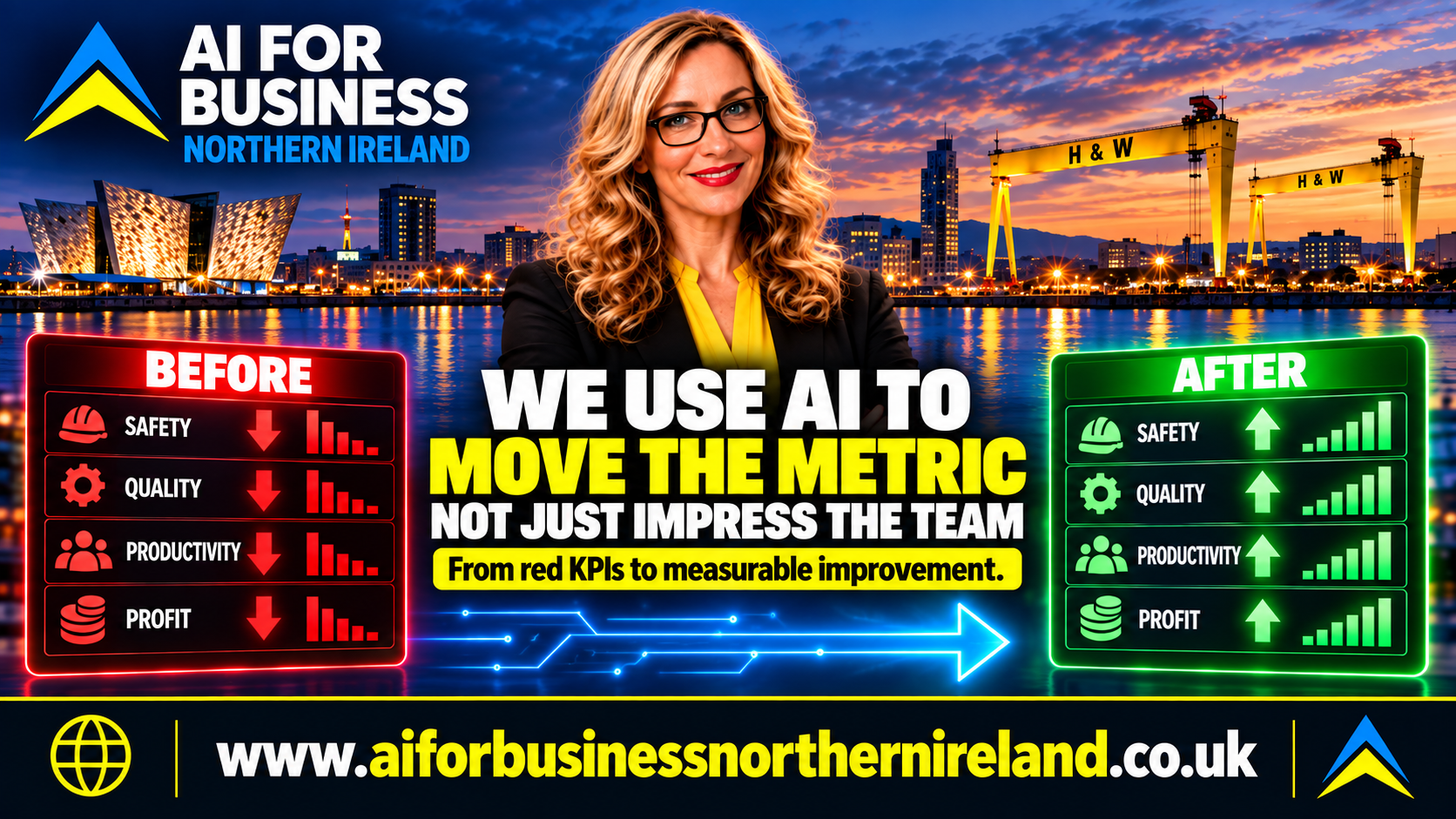
𝐖𝐄 𝐔𝐒𝐄 𝐀𝐈 𝐓𝐎 𝐌𝐎𝐕𝐄 𝐓𝐇𝐄 𝐌𝐄𝐓𝐑𝐈𝐂 𝐍𝐎𝐓 𝐉𝐔𝐒𝐓 𝐈𝐌𝐏𝐑𝐄𝐒𝐒 𝐓𝐇𝐄 𝐓𝐄𝐀𝐌
𝐀𝐑𝐓𝐈𝐂𝐋𝐄 𝐒𝐔𝐌𝐌𝐀𝐑𝐘
This article explains how businesses can use AI to improve measurable KPIs including safety, quality, productivity and profit, rather than focusing only on AI adoption or impressive demonstrations.
Lisa Wallace of AI For Business Northern Ireland draws on more than 20 years of Lean, operational excellence, process improvement and performance management experience to show how AI should be linked to baselines, business metrics, capacity released, ROI, governance and implementation.
It also covers RoleMap™ AI, Automate or Not™, AI training, AI governance and practical ways leadership teams can turn AI activity into measurable business value.
There is a point in almost every AI conversation where somebody says:
𝐋𝐨𝐨𝐤 𝐰𝐡𝐚𝐭 𝐢𝐭 𝐜𝐚𝐧 𝐝𝐨.
And yes, sometimes it is impressive.
The demo works.
The summary appears in seconds.
The agent completes the task.
The Copilot produces the report.
The chatbot answers the question.
Everyone nods.
Someone says, “That’s amazing.”
Then I ask the question that tends to make the room slightly quieter:
𝐖𝐡𝐢𝐜𝐡 𝐊𝐏𝐈 𝐝𝐢𝐝 𝐢𝐭 𝐢𝐦𝐩𝐫𝐨𝐯𝐞?
That is the part I care about.
Because AI is not valuable because it is clever.
AI is valuable when it improves something the business already cares about.
𝐒𝐚𝐟𝐞𝐭𝐲.
𝐐𝐮𝐚𝐥𝐢𝐭𝐲.
𝐏𝐫𝐨𝐝𝐮𝐜𝐭𝐢𝐯𝐢𝐭𝐲.
𝐏𝐫𝐨𝐟𝐢𝐭.
That is why my approach at 𝐀𝐈 𝐅𝐨𝐫 𝐁𝐮𝐬𝐢𝐧𝐞𝐬𝐬 𝐍𝐨𝐫𝐭𝐡𝐞𝐫𝐧 𝐈𝐫𝐞𝐥𝐚𝐧𝐝 is simple:
𝐖𝐄 𝐔𝐒𝐄 𝐀𝐈 𝐓𝐎 𝐌𝐎𝐕𝐄 𝐓𝐇𝐄 𝐌𝐄𝐓𝐑𝐈𝐂, 𝐍𝐎𝐓 𝐉𝐔𝐒𝐓 𝐈𝐌𝐏𝐑𝐄𝐒𝐒 𝐓𝐇𝐄 𝐓𝐄𝐀𝐌.
And 2026 research is making that distinction increasingly important.
𝐀𝐈 𝐀𝐃𝐎𝐏𝐓𝐈𝐎𝐍 𝐈𝐒 𝐑𝐈𝐒𝐈𝐍𝐆. 𝐁𝐔𝐒𝐈𝐍𝐄𝐒𝐒 𝐈𝐌𝐏𝐀𝐂𝐓 𝐈𝐒 𝐌𝐔𝐂𝐇 𝐇𝐀𝐑𝐃𝐄𝐑 𝐓𝐎 𝐏𝐑𝐎𝐕𝐄.
The UK Government’s 2026 AI Adoption Research found that 75% of businesses already using AI reported improved workforce productivity, and 57% said they had developed new or improved processes or operations.
Sounds excellent.
But here is the part that should make every leadership team pay attention:
𝟕𝟕% 𝐬𝐚𝐢𝐝 𝐀𝐈 𝐡𝐚𝐝 𝐧𝐨𝐭 𝐲𝐞𝐭 𝐜𝐡𝐚𝐧𝐠𝐞𝐝 𝐭𝐡𝐞𝐢𝐫 𝐫𝐞𝐯𝐞𝐧𝐮𝐞.
Only 12% reported an increase in revenue.
That does not mean AI is failing.
It means 𝐩𝐫𝐨𝐝𝐮𝐜𝐭𝐢𝐯𝐢𝐭𝐲 𝐢𝐬 𝐧𝐨𝐭 𝐭𝐡𝐞 𝐬𝐚𝐦𝐞 𝐚𝐬 𝐛𝐮𝐬𝐢𝐧𝐞𝐬𝐬 𝐯𝐚𝐥𝐮𝐞.
Saving an employee 30 minutes is an efficiency.
Knowing what happens to that 30 minutes afterwards is benefits realisation.
Does it reduce backlog?
Does it improve quality?
Does the employee spend more time with customers?
Does it increase output?
Does it eliminate overtime?
Does it improve first-time-right performance?
Does it prevent the next defect?
Does it increase revenue?
Or does the saved time disappear into another meeting?
That is the difference between measuring 𝐀𝐈 𝐚𝐜𝐭𝐢𝐯𝐢𝐭𝐲 and measuring 𝐛𝐮𝐬𝐢𝐧𝐞𝐬𝐬 𝐩𝐞𝐫𝐟𝐨𝐫𝐦𝐚𝐧𝐜𝐞.
𝐓𝐇𝐄 𝟐𝟎𝟐𝟔 𝐑𝐄𝐒𝐄𝐀𝐑𝐂𝐇 𝐈𝐒 𝐌𝐎𝐕𝐈𝐍𝐆 𝐈𝐍 𝐄𝐗𝐀𝐂𝐓𝐋𝐘 𝐓𝐇𝐈𝐒 𝐃𝐈𝐑𝐄𝐂𝐓𝐈𝐎𝐍
McKinsey’s 2026 research on AI measurement makes a very similar point: organisations need to move beyond adoption statistics and measure AI against customer, operational and bottom-line impact.
Their work specifically argues that companies need accountability and clear measures if they want to scale what works rather than simply scale what is interesting.
Their September research goes even further.
McKinsey reports that 80% of respondents say AI has improved individual productivity, but only 37% attribute any EBIT impact to AI use.
Only 6% qualified as high performers, attributing at least 5% of EBIT to AI and describing the impact as significant.
That is a very useful gap to understand.
𝐏𝐞𝐨𝐩𝐥𝐞 𝐜𝐚𝐧 𝐛𝐞 𝐠𝐞𝐭𝐭𝐢𝐧𝐠 𝐟𝐚𝐬𝐭𝐞𝐫 𝐰𝐢𝐭𝐡𝐨𝐮𝐭 𝐭𝐡𝐞 𝐛𝐮𝐬𝐢𝐧𝐞𝐬𝐬 𝐛𝐞𝐜𝐨𝐦𝐢𝐧𝐠 𝐛𝐞𝐭𝐭𝐞𝐫.
KPMG’s Q2 2026 Global AI Pulse reaches a similar conclusion.
Only 7% of leaders reported established ROI from AI, while organisations with stronger cost visibility and clearer accountability were materially more likely to report measurable value.
So perhaps we need to stop asking:
𝐇𝐨𝐰 𝐦𝐚𝐧𝐲 𝐩𝐞𝐨𝐩𝐥𝐞 𝐚𝐫𝐞 𝐮𝐬𝐢𝐧𝐠 𝐀𝐈?
and start asking:
𝐖𝐡𝐚𝐭 𝐦𝐨𝐯𝐞𝐝?
𝐓𝐖𝐄𝐍𝐓𝐘 𝐓𝐖𝐄𝐍𝐓𝐘-𝐒𝐈𝐗 𝐀𝐈 𝐑𝐄𝐒𝐄𝐀𝐑𝐂𝐇: 𝐀𝐃𝐎𝐏𝐓𝐈𝐎𝐍 𝐕𝐄𝐑𝐒𝐔𝐒 𝐌𝐄𝐀𝐒𝐔𝐑𝐀𝐁𝐋𝐄 𝐕𝐀𝐋𝐔𝐄
┌───────────────────────────────────┐
│ UK GOVERNMENT AI ADOPTION RESEARCH │
└───────────────────────────────────┘
𝐖𝐡𝐚𝐭 𝐭𝐡𝐞 𝐫𝐞𝐬𝐞𝐚𝐫𝐜𝐡 𝐟𝐨𝐮𝐧𝐝:
75% of AI users reported workforce productivity improvement, but 77% reported no change in revenue.
𝐓𝐡𝐞 𝐊𝐏𝐈 𝐪𝐮𝐞𝐬𝐭𝐢𝐨𝐧 𝐈 𝐰𝐨𝐮𝐥𝐝 𝐚𝐬𝐤:
Where did the productivity gain go?
𝐒𝐨𝐮𝐫𝐜𝐞:
UK Government, AI Adoption Research, 2026
https://www.gov.uk/government/publications/ai-adoption-research/ai-adoption-research
┌───────────────────────────────┐
│ McKINSEY — STATE OF AI 2026 │
└───────────────────────────────┘
𝐖𝐡𝐚𝐭 𝐭𝐡𝐞 𝐫𝐞𝐬𝐞𝐚𝐫𝐜𝐡 𝐟𝐨𝐮𝐧𝐝:
80% reported individual productivity gains, but only 37% attributed EBIT impact to AI.
𝐓𝐡𝐞 𝐊𝐏𝐈 𝐪𝐮𝐞𝐬𝐭𝐢𝐨𝐧 𝐈 𝐰𝐨𝐮𝐥𝐝 𝐚𝐬𝐤:
Did individual efficiency improve business performance?
𝐒𝐨𝐮𝐫𝐜𝐞:
McKinsey & Company, Cutting the Coordination Tax: How Agentic AI Can Reshape Workflows, September 2026
https://www.mckinsey.com/industries/industrials/our-insights/cutting-the-coordination-tax-how-agentic-ai-can-reshape-workflows
┌──────────────────────────────────┐
│ KPMG GLOBAL AI PULSE Q2 2026 │
└──────────────────────────────────┘
𝐖𝐡𝐚𝐭 𝐭𝐡𝐞 𝐫𝐞𝐬𝐞𝐚𝐫𝐜𝐡 𝐟𝐨𝐮𝐧𝐝:
Only 7% reported established ROI; organisations with better cost visibility achieved stronger ROI.
𝐓𝐡𝐞 𝐊𝐏𝐈 𝐪𝐮𝐞𝐬𝐭𝐢𝐨𝐧 𝐈 𝐰𝐨𝐮𝐥𝐝 𝐚𝐬𝐤:
Can you see the full cost and return?
𝐒𝐨𝐮𝐫𝐜𝐞:
KPMG, Global AI Pulse Q2 2026
https://kpmg.com/xx/en/media/press-releases/2026/06/growing-adoption-signals-progress-as-cost-visibility-and-accountability-drive-ai-value.html
┌──────────────────────────────┐
│ KPMG UK 2026 │
└──────────────────────────────┘
𝐖𝐡𝐚𝐭 𝐭𝐡𝐞 𝐫𝐞𝐬𝐞𝐚𝐫𝐜𝐡 𝐟𝐨𝐮𝐧𝐝:
Leaders reported confidence measuring productivity, quality, decision speed and profitability, but risk, data quality and adoption remained major barriers.
𝐓𝐡𝐞 𝐊𝐏𝐈 𝐪𝐮𝐞𝐬𝐭𝐢𝐨𝐧 𝐈 𝐰𝐨𝐮𝐥𝐝 𝐚𝐬𝐤:
Are KPI improvements being tracked alongside adoption and risk?
𝐒𝐨𝐮𝐫𝐜𝐞:
KPMG UK, 2026 AI research
https://kpmg.com/uk/en/media/press-releases/2026/04/ai-no-longer-needs-traditional-return.html
┌──────────────────────────────────────┐
│ McKINSEY OPERATIONAL EXCELLENCE 2026 │
└──────────────────────────────────────┘
𝐖𝐡𝐚𝐭 𝐭𝐡𝐞 𝐫𝐞𝐬𝐞𝐚𝐫𝐜𝐡 𝐟𝐨𝐮𝐧𝐝:
Almost 90% of organisations were experimenting with AI, but only 7% reported scaling it across the enterprise.
𝐓𝐡𝐞 𝐊𝐏𝐈 𝐪𝐮𝐞𝐬𝐭𝐢𝐨𝐧 𝐈 𝐰𝐨𝐮𝐥𝐝 𝐚𝐬𝐤:
What is stopping proven improvement from being scaled?
𝐒𝐨𝐮𝐫𝐜𝐞:
McKinsey & Company, Putting AI to Work: The Operational Excellence Imperative, June 2026
https://www.mckinsey.com/capabilities/operations/our-insights/putting-ai-to-work-the-operational-excellence-imperative
And this is why I believe 𝐀𝐈 𝐭𝐫𝐚𝐧𝐬𝐟𝐨𝐫𝐦𝐚𝐭𝐢𝐨𝐧 𝐛𝐞𝐥𝐨𝐧𝐠𝐬 𝐣𝐮𝐬𝐭 𝐚𝐬 𝐦𝐮𝐜𝐡 𝐢𝐧 𝐨𝐩𝐞𝐫𝐚𝐭𝐢𝐨𝐧𝐚𝐥 𝐞𝐱𝐜𝐞𝐥𝐥𝐞𝐧𝐜𝐞 𝐚𝐬 𝐢𝐭 𝐝𝐨𝐞𝐬 𝐢𝐧 𝐈𝐓.
𝐈 𝐇𝐀𝐕𝐄 𝐒𝐏𝐄𝐍𝐓 𝐌𝐎𝐑𝐄 𝐓𝐇𝐀𝐍 𝟐𝟎 𝐘𝐄𝐀𝐑𝐒 𝐋𝐈𝐕𝐈𝐍𝐆 𝐈𝐍𝐒𝐈𝐃𝐄 𝐊𝐏𝐈𝐒
Before I ever worked with AI, my career was built around performance.
Manufacturing engineering.
Lean.
Operational excellence.
Process improvement.
Business improvement.
Change.
Performance management.
And when you work in those environments, you learn fairly quickly that nobody is impressed for long by an activity.
They want the result.
The machine either runs or it does not.
The defect rate either improves or it does not.
The build time either reduces or it does not.
The capacity either increases or it does not.
The customer either waits less or they do not.
The red KPI either moves towards green or it does not.
That way of thinking has never left me.
And it is exactly how I now approach AI.
𝐈 𝐇𝐀𝐕𝐄 𝐌𝐎𝐕𝐄𝐃 𝐌𝐄𝐓𝐑𝐈𝐂𝐒 𝐁𝐄𝐅𝐎𝐑𝐄 𝐀𝐈 𝐄𝐍𝐓𝐄𝐑𝐄𝐃 𝐓𝐇𝐄 𝐂𝐎𝐍𝐕𝐄𝐑𝐒𝐀𝐓𝐈𝐎𝐍
My own operational improvement work has included measurable results across manufacturing and engineering.
At GE Energy, a structured root-cause improvement programme helped reduce dead-on-arrival parts and component contamination, producing a 43% parts-quality improvement.
At Bombardier, Kaizen activity on an automated riveting machine delivered a 40% improvement in machine downtime, alongside separate projects that achieved a 23% reduction in build time and a 23% improvement in skin-undulation performance.
At Caterpillar, a paint-line improvement project increased efficiency by 30%, while a moving-flow-line project increased build capacity by 20%.
Those results matter to me because they shaped the way I think.
I do not see AI as a separate universe.
I see it as another capability we can apply to improve how work gets done.
The principles are remarkably familiar:
𝐔𝐧𝐝𝐞𝐫𝐬𝐭𝐚𝐧𝐝 𝐭𝐡𝐞 𝐩𝐫𝐨𝐜𝐞𝐬𝐬.
𝐅𝐢𝐧𝐝 𝐭𝐡𝐞 𝐰𝐚𝐬𝐭𝐞.
𝐅𝐢𝐧𝐝 𝐭𝐡𝐞 𝐜𝐨𝐧𝐬𝐭𝐫𝐚𝐢𝐧𝐭.
𝐔𝐧𝐝𝐞𝐫𝐬𝐭𝐚𝐧𝐝 𝐭𝐡𝐞 𝐜𝐚𝐮𝐬𝐞.
𝐃𝐞𝐟𝐢𝐧𝐞 𝐭𝐡𝐞 𝐦𝐞𝐚𝐬𝐮𝐫𝐞.
𝐌𝐚𝐤𝐞 𝐭𝐡𝐞 𝐜𝐡𝐚𝐧𝐠𝐞.
𝐂𝐡𝐞𝐜𝐤 𝐭𝐡𝐞 𝐫𝐞𝐬𝐮𝐥𝐭.
𝐒𝐭𝐚𝐧𝐝𝐚𝐫𝐝𝐢𝐬𝐞 𝐰𝐡𝐚𝐭 𝐰𝐨𝐫𝐤𝐬.
𝐈𝐦𝐩𝐫𝐨𝐯𝐞 𝐚𝐠𝐚𝐢𝐧.
AI simply gives us new tools to do some of that faster.
𝐒𝐀𝐅𝐄𝐓𝐘. 𝐐𝐔𝐀𝐋𝐈𝐓𝐘. 𝐏𝐑𝐎𝐃𝐔𝐂𝐓𝐈𝐕𝐈𝐓𝐘. 𝐏𝐑𝐎𝐅𝐈𝐓.
If I am looking at AI in an operational environment, those four categories are a very good place to begin.
Not because every business uses those exact four headings.
But because they force a balanced conversation.
𝐒𝐀𝐅𝐄𝐓𝐘
Can AI reduce exposure to risk?
Can it highlight missed actions?
Can it help identify recurring incidents?
Can it improve compliance visibility?
Can it surface emerging issues earlier?
Can it reduce unnecessary manual handling or administrative burden around safety systems?
But we also need to ask the opposite question:
𝐂𝐨𝐮𝐥𝐝 𝐭𝐡𝐞 𝐀𝐈 𝐢𝐭𝐬𝐞𝐥𝐟 𝐢𝐧𝐭𝐫𝐨𝐝𝐮𝐜𝐞 𝐚 𝐧𝐞𝐰 𝐬𝐚𝐟𝐞𝐭𝐲 𝐨𝐫 𝐨𝐩𝐞𝐫𝐚𝐭𝐢𝐨𝐧𝐚𝐥 𝐫𝐢𝐬𝐤?
That is why governance and human oversight sit alongside improvement.
𝐐𝐔𝐀𝐋𝐈𝐓𝐘
Can AI help reduce defects?
Can it speed corrective-action analysis?
Can it spot recurring complaint themes?
Can it improve audit preparation?
Can it support document control?
Can it identify patterns in non-conformance data?
Can it help people get to root cause faster?
This is where AI can become genuinely interesting.
Not because it writes the quality report faster.
But because the Quality Manager now has more time to investigate why the same problem happened for the fifth time.
𝐏𝐑𝐎𝐃𝐔𝐂𝐓𝐈𝐕𝐈𝐓𝐘
This is the KPI most AI projects naturally gravitate towards.
And that is understandable.
AI can reduce repetitive administration enormously.
But “hours saved” is only half a metric.
I want to know:
𝐖𝐡𝐚𝐭 𝐡𝐚𝐩𝐩𝐞𝐧𝐞𝐝 𝐭𝐨 𝐭𝐡𝐞 𝐡𝐨𝐮𝐫𝐬?
Did throughput improve?
Did response time fall?
Did backlog reduce?
Did capacity increase?
Did managers spend more time managing?
Did engineers spend more time engineering?
Did salespeople spend more time selling?
That is why I believe every AI project that claims to “save time” should have a 𝐜𝐚𝐩𝐚𝐜𝐢𝐭𝐲-𝐫𝐞𝐝𝐢𝐫𝐞𝐜𝐭𝐢𝐨𝐧 𝐩𝐥𝐚𝐧.
𝐏𝐑𝐎𝐅𝐈𝐓
This is where the business case finally has to grow up.
Because eventually someone should ask:
𝐃𝐢𝐝 𝐭𝐡𝐞 𝐛𝐞𝐧𝐞𝐟𝐢𝐭 𝐞𝐱𝐜𝐞𝐞𝐝 𝐭𝐡𝐞 𝐜𝐨𝐬𝐭?
AI has operating costs.
Licences.
Tokens.
Integration.
Training.
Governance.
Implementation.
Monitoring.
Human review.
Maintenance.
The 2026 KPMG research is particularly relevant here.
Organisations with full visibility into AI operating costs were five times more likely to report established ROI globally; KPMG’s UK findings similarly reported materially stronger ROI among organisations with greater cost visibility.
That is why I am increasingly interested in 𝐀𝐈 𝐞𝐜𝐨𝐧𝐨𝐦𝐢𝐜𝐬, not just AI capability.
The cleverest solution is not automatically the best solution.
𝐓𝐇𝐈𝐒 𝐈𝐒 𝐀𝐋𝐒𝐎 𝐖𝐇𝐘 𝐈 𝐂𝐑𝐄𝐀𝐓𝐄𝐃 𝐀𝐔𝐓𝐎𝐌𝐀𝐓𝐄 𝐎𝐑 𝐍𝐎𝐓™
Businesses are being given an extraordinary number of ways to solve the same problem.
Use an LLM.
Build an agent.
Buy Copilot.
Buy a specialist platform.
Create a workflow.
Use RPA.
Build an app.
Integrate a document-search solution.
Automate the whole thing.
Automate half of it.
Or do not automate it at all.
Automate or Not™ exists because I want businesses to compare those routes before committing money.
The question is not:
𝐂𝐚𝐧 𝐀𝐈 𝐝𝐨 𝐭𝐡𝐢𝐬?
The better question is:
𝐖𝐡𝐚𝐭 𝐢𝐬 𝐭𝐡𝐞 𝐦𝐨𝐬𝐭 𝐬𝐞𝐧𝐬𝐢𝐛𝐥𝐞 𝐚𝐧𝐝 𝐜𝐨𝐬𝐭-𝐞𝐟𝐟𝐞𝐜𝐭𝐢𝐯𝐞 𝐰𝐚𝐲 𝐭𝐨 𝐢𝐦𝐩𝐫𝐨𝐯𝐞 𝐭𝐡𝐢𝐬?
That might be generative AI.
It might be workflow automation.
It might be an agent.
It might be process redesign.
Sometimes the best technology decision is 𝐧𝐨𝐭 𝐛𝐮𝐲𝐢𝐧𝐠 𝐦𝐨𝐫𝐞 𝐭𝐞𝐜𝐡𝐧𝐨𝐥𝐨𝐠𝐲.
𝐀𝐍𝐃 𝐓𝐇𝐈𝐒 𝐈𝐒 𝐖𝐇𝐄𝐑𝐄 𝐑𝐎𝐋𝐄𝐌𝐀𝐏™ 𝐀𝐈 𝐂𝐎𝐍𝐍𝐄𝐂𝐓𝐒 𝐂𝐀𝐏𝐀𝐂𝐈𝐓𝐘 𝐓𝐎 𝐊𝐏𝐈𝐒
One of the reasons I created RoleMap™ AI was because job-level AI discussions are often far too simplistic.
People ask:
𝐂𝐚𝐧 𝐭𝐡𝐢𝐬 𝐣𝐨𝐛 𝐛𝐞 𝐚𝐮𝐭𝐨𝐦𝐚𝐭𝐞𝐝?
I think that is usually the wrong question.
Jobs are collections of tasks.
Some need judgement.
Some need leadership.
Some need empathy.
Some need experience.
Some are repetitive administration.
Some are waiting.
Some are duplication.
Some are genuine improvement opportunities.
RoleMap™ AI maps those tasks and identifies where AI, automation or process improvement may help, while protecting the work that should remain human-led.
In one Quality Manager analysis, RoleMap™ AI identified up to 42.67 hours of potential capacity per month.
That sounds good.
But the number itself is not the business case.
The real question is:
𝐖𝐡𝐚𝐭 𝐜𝐨𝐮𝐥𝐝 𝐚𝐧 𝐞𝐱𝐩𝐞𝐫𝐢𝐞𝐧𝐜𝐞𝐝 𝐐𝐮𝐚𝐥𝐢𝐭𝐲 𝐌𝐚𝐧𝐚𝐠𝐞𝐫 𝐝𝐨 𝐰𝐢𝐭𝐡 𝐚𝐧𝐨𝐭𝐡𝐞𝐫 𝐰𝐨𝐫𝐤𝐢𝐧𝐠 𝐰𝐞𝐞𝐤 𝐞𝐯𝐞𝐫𝐲 𝐦𝐨𝐧𝐭𝐡?
Investigate repeat defects.
Close corrective actions faster.
Spend more time with suppliers.
Coach the team.
Improve audit readiness.
Prevent problems.
Reduce cost of poor quality.
That is when capacity begins to move a KPI.
My website now includes further RoleMap™ AI examples, including 60.44 hours per month identified for a Lean Transformation Change Agent and 47.9 hours for a Mortgage Lending Operations Manager.
These are potential capacity estimates that need to be validated through real implementation and measurement, not guaranteed savings.
That distinction matters.
Because I am not interested in manufacturing impressive numbers.
I am interested in finding out whether they survive contact with the real process.
𝐀𝐈 𝐍𝐄𝐄𝐃𝐒 𝐀 𝐁𝐀𝐒𝐄𝐋𝐈𝐍𝐄 𝐁𝐄𝐅𝐎𝐑𝐄 𝐈𝐓 𝐍𝐄𝐄𝐃𝐒 𝐀 𝐂𝐄𝐋𝐄𝐁𝐑𝐀𝐓𝐈𝐎𝐍
If you want to know whether AI moved the metric, you need to know where the metric started.
This sounds obvious.
It is astonishing how often it is skipped.
Before implementation I want:
𝐁𝐚𝐬𝐞𝐥𝐢𝐧𝐞.
𝐕𝐨𝐥𝐮𝐦𝐞.
𝐂𝐮𝐫𝐫𝐞𝐧𝐭 𝐭𝐢𝐦𝐞.
𝐂𝐮𝐫𝐫𝐞𝐧𝐭 𝐜𝐨𝐬𝐭.
𝐂𝐮𝐫𝐫𝐞𝐧𝐭 𝐞𝐫𝐫𝐨𝐫 𝐫𝐚𝐭𝐞.
𝐂𝐮𝐫𝐫𝐞𝐧𝐭 𝐪𝐮𝐚𝐥𝐢𝐭𝐲.
𝐂𝐮𝐫𝐫𝐞𝐧𝐭 𝐛𝐚𝐜𝐤𝐥𝐨𝐠.
𝐂𝐮𝐫𝐫𝐞𝐧𝐭 𝐜𝐮𝐬𝐭𝐨𝐦𝐞𝐫 𝐦𝐞𝐚𝐬𝐮𝐫𝐞.
𝐂𝐮𝐫𝐫𝐞𝐧𝐭 𝐩𝐫𝐨𝐝𝐮𝐜𝐭𝐢𝐯𝐢𝐭𝐲.
𝐂𝐮𝐫𝐫𝐞𝐧𝐭 𝐫𝐢𝐬𝐤.
Then we can define the target.
Then we implement.
Then we measure.
Without a baseline, a 20% improvement can become whatever anyone wants it to mean.
And that is not continuous improvement.
That is creative writing.
𝐓𝐇𝐈𝐒 𝐈𝐒 𝐖𝐇𝐘 𝐈𝐌𝐏𝐋𝐄𝐌𝐄𝐍𝐓𝐀𝐓𝐈𝐎𝐍 𝐌𝐀𝐓𝐓𝐄𝐑𝐒 𝐌𝐎𝐑𝐄 𝐓𝐇𝐀𝐍 𝐑𝐄𝐂𝐎𝐌𝐌𝐄𝐍𝐃𝐀𝐓𝐈𝐎𝐍𝐒
I do not want to walk into a business, point at five AI opportunities and disappear.
That is not transformation.
At AI For Business Northern Ireland, our work can include the practical tools needed to move from idea to implementation:
𝐏𝐫𝐨𝐜𝐞𝐬𝐬 𝐦𝐚𝐩𝐬.
𝐀𝐈 𝐨𝐩𝐩𝐨𝐫𝐭𝐮𝐧𝐢𝐭𝐲 𝐚𝐬𝐬𝐞𝐬𝐬𝐦𝐞𝐧𝐭𝐬.
𝐑𝐨𝐥𝐞𝐌𝐚𝐩™ 𝐀𝐈 𝐫𝐞𝐩𝐨𝐫𝐭𝐬.
𝐀𝐮𝐭𝐨𝐦𝐚𝐭𝐞 𝐨𝐫 𝐍𝐨𝐭™ 𝐜𝐨𝐦𝐩𝐚𝐫𝐢𝐬𝐨𝐧𝐬.
𝐈𝐦𝐩𝐥𝐞𝐦𝐞𝐧𝐭𝐚𝐭𝐢𝐨𝐧 𝐩𝐥𝐚𝐧𝐬.
𝟑𝟎/𝟔𝟎/𝟗𝟎-𝐝𝐚𝐲 𝐭𝐫𝐚𝐧𝐬𝐢𝐭𝐢𝐨𝐧 𝐩𝐥𝐚𝐧𝐬.
𝐀𝐈 𝐠𝐨𝐯𝐞𝐫𝐧𝐚𝐧𝐜𝐞 𝐭𝐞𝐦𝐩𝐥𝐚𝐭𝐞𝐬.
𝐑𝐢𝐬𝐤 𝐫𝐞𝐠𝐢𝐬𝐭𝐞𝐫𝐬.
𝐄𝐯𝐢𝐝𝐞𝐧𝐜𝐞 𝐥𝐨𝐠𝐬.
𝐑𝐞𝐥𝐞𝐚𝐬𝐞 𝐜𝐨𝐧𝐭𝐫𝐨𝐥𝐬.
𝐓𝐫𝐚𝐢𝐧𝐢𝐧𝐠 𝐩𝐥𝐚𝐧𝐬.
𝐑𝐨𝐥𝐞-𝐬𝐩𝐞𝐜𝐢𝐟𝐢𝐜 𝐭𝐫𝐚𝐢𝐧𝐢𝐧𝐠.
𝐀𝐈 𝐜𝐡𝐚𝐦𝐩𝐢𝐨𝐧𝐬.
𝐏𝐞𝐫𝐟𝐨𝐫𝐦𝐚𝐧𝐜𝐞 𝐝𝐚𝐬𝐡𝐛𝐨𝐚𝐫𝐝𝐬.
𝐑𝐎𝐈 𝐭𝐫𝐚𝐜𝐤𝐢𝐧𝐠.
𝐂𝐨𝐧𝐭𝐢𝐧𝐮𝐨𝐮𝐬-𝐢𝐦𝐩𝐫𝐨𝐯𝐞𝐦𝐞𝐧𝐭 𝐫𝐞𝐯𝐢𝐞𝐰𝐬.
Our AI consulting framework explicitly includes identifying the opportunity, mapping the work, protecting the business, applying the right solution, creating capability and tracking the impact through adoption, time saved, ROI and performance dashboards.
That is important.
Because knowing what to do and actually getting it done are two completely different business capabilities.
𝐀𝐈 𝐓𝐑𝐀𝐍𝐒𝐅𝐎𝐑𝐌𝐀𝐓𝐈𝐎𝐍 𝐖𝐈𝐓𝐇𝐎𝐔𝐓 𝐏𝐑𝐎𝐂𝐄𝐒𝐒 𝐈𝐌𝐏𝐑𝐎𝐕𝐄𝐌𝐄𝐍𝐓 𝐂𝐀𝐍 𝐀𝐔𝐓𝐎𝐌𝐀𝐓𝐄 𝐓𝐇𝐄 𝐖𝐑𝐎𝐍𝐆 𝐓𝐇𝐈𝐍𝐆 𝐁𝐄𝐀𝐔𝐓𝐈𝐅𝐔𝐋𝐋𝐘
McKinsey’s June 2026 research makes operational excellence central to scaling AI.
Almost 90% of organisations said they were at least experimenting with AI, but only 7% reported scaling it across the enterprise.
Their conclusion is that operational excellence is an important accelerator of AI at scale.
That does not surprise me.
If the process is already unclear, fragmented or full of waste, adding AI does not magically create clarity.
Sometimes it simply makes the waste travel faster.
I would rather remove five unnecessary process steps than build an AI agent to navigate them elegantly.
That is the Lean part of me.
It is difficult to switch off.
𝐖𝐇𝐎 𝐈𝐒 𝐓𝐇𝐈𝐒 𝐀𝐏𝐏𝐑𝐎𝐀𝐂𝐇 𝐅𝐎𝐑?
This is particularly relevant if you are:
𝐀 𝐂𝐄𝐎 𝐨𝐫 𝐌𝐚𝐧𝐚𝐠𝐢𝐧𝐠 𝐃𝐢𝐫𝐞𝐜𝐭𝐨𝐫 who keeps hearing about AI but wants to know what it will actually do for the business.
𝐀𝐧 𝐎𝐩𝐞𝐫𝐚𝐭𝐢𝐨𝐧𝐬 𝐃𝐢𝐫𝐞𝐜𝐭𝐨𝐫 responsible for safety, quality, productivity, capacity, cost or service.
𝐀 𝐌𝐚𝐧𝐮𝐟𝐚𝐜𝐭𝐮𝐫𝐢𝐧𝐠 𝐥𝐞𝐚𝐝𝐞𝐫 trying to improve downtime, quality, flow, reporting or production performance.
𝐀 𝐂𝐅𝐎 𝐨𝐫 𝐅𝐢𝐧𝐚𝐧𝐜𝐞 𝐥𝐞𝐚𝐝𝐞𝐫 asking whether AI benefits are real and whether the economics stack up.
𝐀𝐧 𝐇𝐑 𝐨𝐫 𝐏𝐞𝐨𝐩𝐥𝐞 𝐥𝐞𝐚𝐝𝐞𝐫 trying to understand how roles should change when repetitive work is reduced.
𝐀 𝐐𝐮𝐚𝐥𝐢𝐭𝐲 𝐥𝐞𝐚𝐝𝐞𝐫 who needs AI to improve prevention and decision-making, not simply produce prettier reports.
𝐀 𝐂𝐨𝐧𝐭𝐢𝐧𝐮𝐨𝐮𝐬 𝐈𝐦𝐩𝐫𝐨𝐯𝐞𝐦𝐞𝐧𝐭 𝐨𝐫 𝐋𝐞𝐚𝐧 𝐩𝐫𝐨𝐟𝐞𝐬𝐬𝐢𝐨𝐧𝐚𝐥 who sees enormous AI potential but does not want technology to bypass good problem-solving.
𝐀𝐧 𝐈𝐓 𝐨𝐫 𝐃𝐢𝐠𝐢𝐭𝐚𝐥 𝐥𝐞𝐚𝐝𝐞𝐫 who wants business ownership and measurable outcomes around AI implementation.
𝐀 𝐥𝐞𝐚𝐝𝐞𝐫𝐬𝐡𝐢𝐩 𝐭𝐞𝐚𝐦 that has already bought AI tools and is now asking the awkward but necessary question:
𝐖𝐡𝐚𝐭 𝐚𝐫𝐞 𝐰𝐞 𝐚𝐜𝐭𝐮𝐚𝐥𝐥𝐲 𝐠𝐞𝐭𝐭𝐢𝐧𝐠 𝐛𝐚𝐜𝐤?
𝐓𝐇𝐄 𝐊𝐏𝐈 𝐈 𝐖𝐎𝐔𝐋𝐃 𝐍𝐎𝐓 𝐈𝐆𝐍𝐎𝐑𝐄: 𝐀𝐃𝐎𝐏𝐓𝐈𝐎𝐍
There is one metric that sits slightly differently from safety, quality, productivity and profit.
Adoption.
Because a theoretically brilliant AI solution that nobody uses has a fairly predictable ROI.
Zero.
KPMG’s 2026 UK research lists employee adoption alongside data quality as one of the major challenges facing AI strategy.
This is why training cannot be an afterthought.
Training should connect directly to the role, process and measure.
Not:
𝐇𝐞𝐫𝐞 𝐚𝐫𝐞 𝟑𝟎 𝐜𝐥𝐞𝐯𝐞𝐫 𝐩𝐫𝐨𝐦𝐩𝐭𝐬.
But:
𝐇𝐞𝐫𝐞 𝐢𝐬 𝐭𝐡𝐞 𝐭𝐚𝐬𝐤 𝐰𝐞 𝐚𝐫𝐞 𝐢𝐦𝐩𝐫𝐨𝐯𝐢𝐧𝐠.
𝐇𝐞𝐫𝐞 𝐢𝐬 𝐡𝐨𝐰 𝐭𝐡𝐞 𝐭𝐨𝐨𝐥 𝐬𝐮𝐩𝐩𝐨𝐫𝐭𝐬 𝐢𝐭.
𝐇𝐞𝐫𝐞 𝐢𝐬 𝐰𝐡𝐚𝐭 𝐫𝐞𝐦𝐚𝐢𝐧𝐬 𝐡𝐮𝐦𝐚𝐧-𝐥𝐞𝐝.
𝐇𝐞𝐫𝐞 𝐢𝐬 𝐭𝐡𝐞 𝐜𝐨𝐧𝐭𝐫𝐨𝐥.
𝐇𝐞𝐫𝐞 𝐢𝐬 𝐭𝐡𝐞 𝐊𝐏𝐈.
𝐇𝐞𝐫𝐞 𝐢𝐬 𝐡𝐨𝐰 𝐰𝐞 𝐰𝐢𝐥𝐥 𝐤𝐧𝐨𝐰 𝐰𝐡𝐞𝐭𝐡𝐞𝐫 𝐢𝐭 𝐰𝐨𝐫𝐤𝐞𝐝.
Our ALPINE™ Corporate AI Training approach is designed around that practical adoption journey, supported by RoleMap™ AI, governance tools, role-specific training and implementation support.
𝐀 𝐊𝐏𝐈 𝐃𝐀𝐒𝐇𝐁𝐎𝐀𝐑𝐃 𝐒𝐇𝐎𝐔𝐋𝐃 𝐓𝐄𝐋𝐋 𝐀 𝐒𝐓𝐎𝐑𝐘
When I see a KPI move from red to green, I do not just want the green.
I want the story underneath it.
What changed?
Who changed it?
Was AI responsible?
Was process redesign responsible?
Was it training?
Was it a temporary spike?
What unintended effect occurred elsewhere?
Can we sustain it?
Can we replicate it?
Should we scale it?
This is where performance management becomes more interesting than a dashboard.
The metric is the signal.
The work underneath it is the system.
And if you cannot explain the relationship between the AI intervention and the change in performance, you have correlation.
Not proof.
𝐓𝐇𝐄 𝐀𝐈 𝐓𝐑𝐀𝐍𝐒𝐅𝐎𝐑𝐌𝐀𝐓𝐈𝐎𝐍 𝐂𝐇𝐀𝐈𝐍 𝐈 𝐖𝐀𝐍𝐓 𝐓𝐎 𝐒𝐄𝐄
For a serious AI project, I want this chain visible:
𝐁𝐮𝐬𝐢𝐧𝐞𝐬𝐬 𝐩𝐚𝐢𝐧 𝐩𝐨𝐢𝐧𝐭
→ 𝐜𝐮𝐫𝐫𝐞𝐧𝐭 𝐩𝐫𝐨𝐜𝐞𝐬𝐬
→ 𝐛𝐚𝐬𝐞𝐥𝐢𝐧𝐞 𝐊𝐏𝐈
→ 𝐀𝐈 𝐨𝐩𝐩𝐨𝐫𝐭𝐮𝐧𝐢𝐭𝐲
→ 𝐜𝐡𝐨𝐬𝐞𝐧 𝐢𝐧𝐭𝐞𝐫𝐯𝐞𝐧𝐭𝐢𝐨𝐧
→ 𝐡𝐮𝐦𝐚𝐧 𝐫𝐨𝐥𝐞
→ 𝐠𝐨𝐯𝐞𝐫𝐧𝐚𝐧𝐜𝐞 𝐜𝐨𝐧𝐭𝐫𝐨𝐥𝐬
→ 𝐢𝐦𝐩𝐥𝐞𝐦𝐞𝐧𝐭𝐚𝐭𝐢𝐨𝐧 𝐩𝐥𝐚𝐧
→ 𝐚𝐝𝐨𝐩𝐭𝐢𝐨𝐧 𝐦𝐞𝐚𝐬𝐮𝐫𝐞
→ 𝐜𝐚𝐩𝐚𝐜𝐢𝐭𝐲 𝐫𝐞𝐥𝐞𝐚𝐬𝐞𝐝
→ 𝐜𝐚𝐩𝐚𝐜𝐢𝐭𝐲 𝐫𝐞𝐝𝐢𝐫𝐞𝐜𝐭𝐞𝐝
→ 𝐊𝐏𝐈 𝐢𝐦𝐩𝐫𝐨𝐯𝐞𝐦𝐞𝐧𝐭
→ 𝐟𝐢𝐧𝐚𝐧𝐜𝐢𝐚𝐥/𝐛𝐮𝐬𝐢𝐧𝐞𝐬𝐬 𝐯𝐚𝐥𝐮𝐞
That is much closer to how I think about AI transformation.
Not:
𝐁𝐮𝐲 𝐥𝐢𝐜𝐞𝐧𝐜𝐞 → 𝐬𝐞𝐧𝐝 𝐭𝐫𝐚𝐢𝐧𝐢𝐧𝐠 𝐢𝐧𝐯𝐢𝐭𝐞 → 𝐡𝐨𝐩𝐞.
𝐒𝐎 𝐖𝐇𝐀𝐓 𝐒𝐇𝐎𝐔𝐋𝐃 𝐋𝐄𝐀𝐃𝐄𝐑𝐒𝐇𝐈𝐏 𝐀𝐒𝐊 𝐀𝐓 𝐓𝐇𝐄 𝐍𝐄𝐗𝐓 𝐀𝐈 𝐑𝐄𝐕𝐈𝐄𝐖?
Not:
𝐇𝐨𝐰 𝐦𝐚𝐧𝐲 𝐥𝐢𝐜𝐞𝐧𝐜𝐞𝐬 𝐡𝐚𝐯𝐞 𝐰𝐞 𝐚𝐜𝐭𝐢𝐯𝐚𝐭𝐞𝐝?
Ask:
𝐖𝐡𝐢𝐜𝐡 𝐊𝐏𝐈 𝐚𝐫𝐞 𝐰𝐞 𝐭𝐫𝐲𝐢𝐧𝐠 𝐭𝐨 𝐦𝐨𝐯𝐞?
𝐖𝐡𝐚𝐭 𝐰𝐚𝐬 𝐭𝐡𝐞 𝐛𝐚𝐬𝐞𝐥𝐢𝐧𝐞?
𝐖𝐡𝐚𝐭 𝐢𝐬 𝐭𝐡𝐞 𝐭𝐚𝐫𝐠𝐞𝐭?
𝐖𝐡𝐨 𝐨𝐰𝐧𝐬 𝐭𝐡𝐞 𝐫𝐞𝐬𝐮𝐥𝐭?
𝐖𝐡𝐚𝐭 𝐡𝐚𝐬 𝐚𝐜𝐭𝐮𝐚𝐥𝐥𝐲 𝐜𝐡𝐚𝐧𝐠𝐞𝐝 𝐢𝐧 𝐭𝐡𝐞 𝐩𝐫𝐨𝐜𝐞𝐬𝐬?
𝐖𝐡𝐚𝐭 𝐜𝐚𝐩𝐚𝐜𝐢𝐭𝐲 𝐡𝐚𝐬 𝐀𝐈 𝐫𝐞𝐥𝐞𝐚𝐬𝐞𝐝?
𝐖𝐡𝐞𝐫𝐞 𝐡𝐚𝐬 𝐭𝐡𝐚𝐭 𝐜𝐚𝐩𝐚𝐜𝐢𝐭𝐲 𝐠𝐨𝐧𝐞?
𝐖𝐡𝐚𝐭 𝐧𝐞𝐰 𝐫𝐢𝐬𝐤 𝐡𝐚𝐬 𝐛𝐞𝐞𝐧 𝐢𝐧𝐭𝐫𝐨𝐝𝐮𝐜𝐞𝐝?
𝐖𝐡𝐚𝐭 𝐝𝐨𝐞𝐬 𝐭𝐡𝐞 𝐬𝐨𝐥𝐮𝐭𝐢𝐨𝐧 𝐜𝐨𝐬𝐭 𝐭𝐨 𝐨𝐩𝐞𝐫𝐚𝐭𝐞?
𝐖𝐡𝐚𝐭 𝐞𝐯𝐢𝐝𝐞𝐧𝐜𝐞 𝐭𝐞𝐥𝐥𝐬 𝐮𝐬 𝐭𝐡𝐞 𝐢𝐦𝐩𝐫𝐨𝐯𝐞𝐦𝐞𝐧𝐭 𝐜𝐚𝐦𝐞 𝐟𝐫𝐨𝐦 𝐭𝐡𝐢𝐬 𝐢𝐧𝐭𝐞𝐫𝐯𝐞𝐧𝐭𝐢𝐨𝐧?
𝐒𝐡𝐨𝐮𝐥𝐝 𝐰𝐞 𝐬𝐜𝐚𝐥𝐞 𝐢𝐭?
Those questions will tell you far more about AI maturity than the number of tools on the technology roadmap.
𝐌𝐘 𝐑𝐔𝐋𝐄 𝐈𝐒 𝐒𝐈𝐌𝐏𝐋𝐄
If the AI is improving the business, we should be able to show it.
If it is saving time, we should know where the time went.
If it is improving quality, we should see the quality metric move.
If it is increasing productivity, we should see output, capacity or cycle time improve.
If it is reducing cost, we should see the cost.
If it is supporting growth, we should see the growth measure.
And if we cannot demonstrate any of those things yet, that does not automatically mean the AI project is bad.
It means we have more work to do before calling it a success.
𝐖𝐄 𝐔𝐒𝐄 𝐀𝐈 𝐓𝐎 𝐌𝐎𝐕𝐄 𝐓𝐇𝐄 𝐌𝐄𝐓𝐑𝐈𝐂, 𝐍𝐎𝐓 𝐉𝐔𝐒𝐓 𝐈𝐌𝐏𝐑𝐄𝐒𝐒 𝐓𝐇𝐄 𝐓𝐄𝐀𝐌
At AI For Business Northern Ireland, I combine more than 20 years of Lean, operational excellence, process improvement and business transformation experience with practical AI implementation.
We do not simply identify where AI might help.
We help businesses turn opportunities into implementation through practical tools, templates, governance, training, implementation planning and benefits tracking.
If your business wants to move from:
𝐀𝐈 𝐞𝐱𝐩𝐞𝐫𝐢𝐦𝐞𝐧𝐭𝐚𝐭𝐢𝐨𝐧 → 𝐦𝐞𝐚𝐬𝐮𝐫𝐚𝐛𝐥𝐞 𝐢𝐦𝐩𝐫𝐨𝐯𝐞𝐦𝐞𝐧𝐭
𝐓𝐢𝐦𝐞 𝐬𝐚𝐯𝐞𝐝 → 𝐜𝐚𝐩𝐚𝐜𝐢𝐭𝐲 𝐫𝐞𝐝𝐞𝐩𝐥𝐨𝐲𝐞𝐝
𝐏𝐢𝐥𝐨𝐭 → 𝐢𝐦𝐩𝐥𝐞𝐦𝐞𝐧𝐭𝐚𝐭𝐢𝐨𝐧
𝐓𝐨𝐨𝐥 𝐚𝐝𝐨𝐩𝐭𝐢𝐨𝐧 → 𝐛𝐮𝐬𝐢𝐧𝐞𝐬𝐬 𝐯𝐚𝐥𝐮𝐞
then that is exactly the work I am interested in.
𝐒𝐓𝐀𝐑𝐓 𝐖𝐈𝐓𝐇 𝐀𝐍 𝐀𝐈 𝐎𝐏𝐏𝐎𝐑𝐓𝐔𝐍𝐈𝐓𝐘 𝐀𝐔𝐃𝐈𝐓
Identify the processes, pain points and opportunities worth tackling first.
https://www.aiforbusinessnorthernireland.co.uk/ai-automation-discovery-audit/Shop
𝐄𝐗𝐏𝐋𝐎𝐑𝐄 𝐎𝐔𝐑 𝐏𝐑𝐀𝐂𝐓𝐈𝐂𝐀𝐋 𝐀𝐈 𝐂𝐎𝐍𝐒𝐔𝐋𝐓𝐈𝐍𝐆 𝐀𝐏𝐏𝐑𝐎𝐀𝐂𝐇
See how we identify opportunities, map work, protect the business, implement the right solution, create capability and track impact.
𝐄𝐗𝐏𝐋𝐎𝐑𝐄 𝐑𝐎𝐋𝐄𝐌𝐀𝐏™ 𝐀𝐈
Understand where AI could support real roles, where work should remain human-led and how released capacity could support the KPIs that matter.
https://www.aiforbusinessnorthernireland.co.uk/shop/RoleMap-AI-Rethink-Roles-Skills-and-Automation-with-AI-p844342894 Shop
𝐄𝐗𝐏𝐋𝐎𝐑𝐄 𝐀𝐈 𝐓𝐑𝐀𝐈𝐍𝐈𝐍𝐆 𝐀𝐍𝐃 𝐀𝐃𝐎𝐏𝐓𝐈𝐎𝐍 𝐒𝐔𝐏𝐏𝐎𝐑𝐓
𝐎𝐑 𝐒𝐓𝐀𝐑𝐓 𝐖𝐈𝐓𝐇 𝐓𝐇𝐄 𝐌𝐀𝐈𝐍 𝐖𝐄𝐁𝐒𝐈𝐓𝐄
AI Agency Belfast | AI for Business Northern Ireland
Because the objective is not to be able to say:
𝐖𝐞 𝐚𝐫𝐞 𝐮𝐬𝐢𝐧𝐠 𝐀𝐈.
The objective is to be able to say:
𝐇𝐄𝐑𝐄 𝐈𝐒 𝐖𝐇𝐀𝐓 𝐈𝐌𝐏𝐑𝐎𝐕𝐄𝐃.