Belfast Built Ships For The World. Now We Are Building The Future With AI
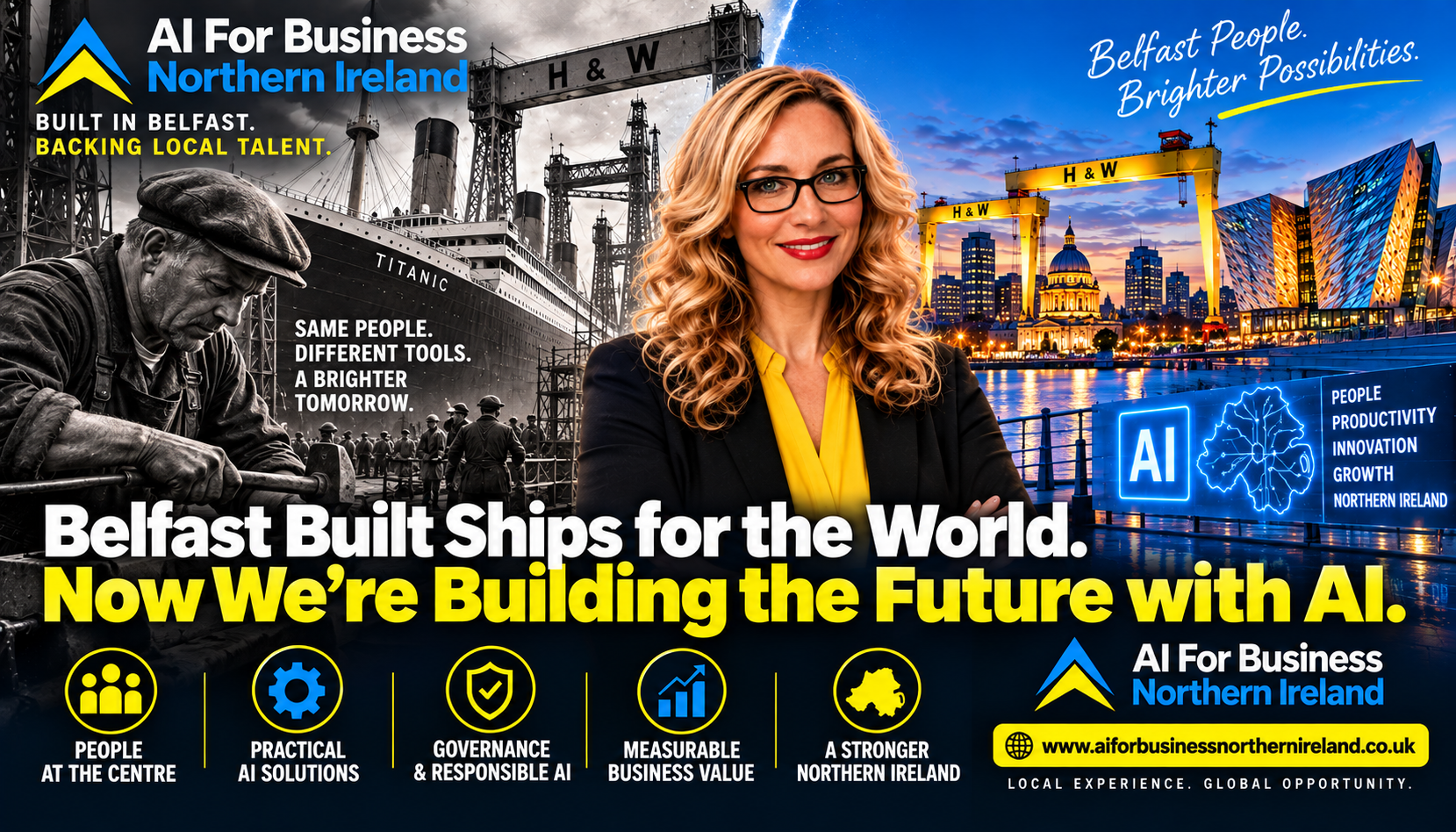
Belfast Built Ships for the World. Now We’re Building the Future with AI.
There is something about standing in Belfast and looking across at the Harland & Wolff cranes that makes you think differently about the word innovation.
They are not just landmarks.
They are a reminder that Belfast has built things the world noticed before.
Ships. Engines. Aircraft. Machinery. Manufacturing capability. Engineering knowledge.
Things that required skill, judgement, problem-solving, resilience and a workforce prepared to get on with the job.
And now another industrial shift is arriving.
Artificial intelligence.
The technology is different.
But the business challenge is surprisingly familiar.
Because the question is not:
“How much AI can we buy?”
The question is:
“What can we build with it that is actually useful?”
That distinction matters.
Northern Ireland does not need more AI hype
Businesses are being bombarded with AI.
New tools.
New agents.
New copilots.
New platforms.
New promises that one piece of software is going to transform everything.
And that is exactly where I think businesses need to be careful.
Buying AI is easy.
Creating measurable business value from it is much harder.
You can give every employee access to an AI tool tomorrow.
That does not automatically mean productivity improves.
You can automate a process.
That does not mean it was the right process to automate.
You can send a team on AI training.
That does not mean they will know how to apply it to their actual jobs on Monday morning.
And you can launch an AI project without ever properly asking:
What business problem are we trying to solve?
That is where I believe AI transformation needs to begin.
We don't start with AI
This is one of the core principles behind AI For Business Northern Ireland:
We don't start with AI.
We start with the business problem.
Before recommending a tool, I want to understand the work.
Where does the time go?
What frustrates employees?
Where are customers waiting?
Where are managers repeatedly producing the same reports?
Where are people copying information between systems?
Where are skilled employees spending hours on work that does not require their skill?
Where are mistakes happening?
Where are decisions being delayed because information is difficult to find?
That is where the opportunity usually lives.
Not in the technology catalogue.
In the work itself.
Role by role. Task by task.
One of the biggest mistakes I see in AI discussions is treating an entire job as though it is one thing.
It isn't.
Every role is made up of dozens of individual tasks.
Some need experience.
Some need judgement.
Some need empathy.
Some need technical expertise.
Some are repetitive.
Some are administrative.
Some require human accountability.
And some may be excellent candidates for AI support.
That thinking led me to build RoleMap™ AI.
Instead of asking:
“Can AI replace this role?”
we ask:
“Which parts of this role could AI support, improve or speed up?”
That is a very different conversation.
And I think it is a much healthier one for businesses and employees.
Because the objective should not simply be removing people.
It should be understanding where technology can give people time back.
An hour released from repetitive reporting can go into quality.
Customer service.
Improvement.
Problem-solving.
Growth.
Better decisions.
That is where AI becomes interesting.
But just because something CAN be automated doesn't mean it SHOULD be
This is another conversation businesses need to have.
There is a danger of turning AI adoption into an automation competition.
“How many processes did we automate?”
“How many agents did we deploy?”
“How many licences did we buy?”
Those are activity measures.
They do not necessarily tell you whether anything became better.
Sometimes generative AI is the right answer.
Sometimes traditional workflow automation is better.
Sometimes RPA makes sense.
Sometimes an AI agent may be appropriate.
Sometimes the process itself needs fixing first.
Sometimes a human should remain firmly in control.
And sometimes the smartest commercial decision is:
Do nothing.
That thinking became Automate or Not™.
Because automation should be a business decision.
Not a fashion decision.
Belfast understands process better than we sometimes give ourselves credit for
Northern Ireland has generations of experience in engineering, manufacturing, aerospace, financial services, public services, logistics, professional services and operations.
We understand processes.
We understand constraints.
We understand quality.
We understand what happens when something that looks good on paper meets the reality of the workplace.
That experience is incredibly valuable in AI.
Because successful AI adoption is not simply a technology project.
It is a process improvement project.
A people project.
A data project.
A governance project.
A training project.
And ultimately, a business performance project.
The organisations that understand that distinction will approach AI very differently from those simply chasing the newest software.
Training cannot be one generic course
There is another problem I think businesses are going to discover.
Generic AI training only gets you so far.
Showing 50 people how to write a prompt is useful.
But the Production Manager does not have the same job as someone in HR.
Finance does not have the same risks as Marketing.
Operations does not use AI in the same way as Sales.
Executives need something different again.
That is why I created the ALPINE™ Corporate AI Training approach.
The emphasis is not simply:
“Here is how ChatGPT or Copilot works.”
It is:
“How does this technology apply to the work you actually do?”
Real jobs.
Real processes.
Real business problems.
Real measures.
Because the technology only matters when something changes afterwards.
And we have to talk about governance
Moving quickly does not mean moving recklessly.
Businesses need to understand where AI is being used.
What data is going into it.
Who owns the process.
What happens when it produces the wrong answer.
Where human review is required.
How decisions are documented.
What suppliers are being used.
What evidence exists that appropriate controls have been considered.
Responsible AI should not sit in a document nobody reads.
It needs to become part of how the organisation actually works.
That is why governance, risk and controls sit alongside automation and training in the work I do.
Because transformation without control can create a completely different problem.
The future does not have to be built somewhere else
This is the part I care about most.
When people talk about AI, the conversation often centres around Silicon Valley.
London.
New York.
Major global technology companies.
But why should Northern Ireland only be a consumer of what somebody else builds?
We have businesses here.
Manufacturers.
Banks.
Professional services firms.
Engineering companies.
Charities.
Public-sector organisations.
SMEs.
Entrepreneurs.
Universities.
Developers.
Consultants.
People who understand operations, customers and real-world problems.
There is no reason Northern Ireland cannot build its own capability around practical business AI.
We do not need to copy somebody else's version of transformation.
We can build one that fits the businesses, people and culture we have here.
Start smaller than you think
If your business is looking at AI and feeling behind, my advice is not to suddenly launch ten AI projects.
Start with one problem.
Understand the process.
Understand the work.
Find the time being lost.
Identify the risk.
Decide whether AI is actually the right solution.
Test it.
Measure it.
Learn.
Then move again.
That is how sustainable transformation happens.
Not through one enormous leap.
Through a series of well-chosen improvements that begin to compound.
Belfast has built ambitious things before.
And the cranes still stand over the city as a reminder of what happens when engineering, skills, people and determination come together.
The tools have changed.
The opportunity has changed.
But the mindset does not have to.
Understand the problem.
Build something useful.
Prove that it works.
Keep people at the centre.
That is the kind of AI future I want to help build from Belfast.
AI For Business Northern Ireland
Built in Belfast. Backing Northern Ireland Business.
If your business is trying to work out where AI genuinely makes sense , from AI discovery and automation to RoleMap™ AI, AI governance and corporate AI training , you can find out more at:
https://www.aiforbusinessnorthernireland.co.uk/