Practical AI Automation Opportunities for Northern Ireland Manufacturers
AI For Business Northern Ireland explains practical AI automation for Northern Ireland manufacturers, including production reporting, quality automation, AI Lean and root-cause analysis.
Manufacturing businesses do not need a warehouse full of robots or a seven-figure technology budget to benefit from AI.
Some of the most valuable AI automation opportunities for manufacturers are much less dramatic.
They are hidden in the spreadsheet updated every morning, the quality report rebuilt every Friday, the supplier shortage chased through email and the corrective action that has somehow become a permanent member of the team.
For Northern Ireland manufacturers, the smartest place to start is rarely with an expensive AI platform.
It is with the work that already wastes time, creates delays, causes rework or makes it harder for experienced people to see what is really happening.
This guide is for manufacturing directors, operations managers, production managers, quality teams, engineering teams, health and safety leaders, Lean practitioners and continuous improvement professionals looking for practical AI automation without unnecessary complexity.
It explains simple manufacturing automation opportunities, where AI Lean thinking should come first and how tools such as FishbotGPT can support stronger root-cause analysis.
Start With the Process, Not the Shiny Tool
Manufacturing has never suffered from a shortage of software.
The problem is that technology is often introduced before the process is properly understood.
A business may automate a report nobody reads, digitise a form that asks the wrong questions or install a new platform around a process filled with duplication, unclear ownership and rework.
That is not transformation.
That is giving waste a password.
AI Lean takes a different approach.
AI Lean combines Lean process improvement with practical AI and automation. The aim is to understand the work first, remove unnecessary steps and then introduce technology where it can genuinely improve safety, quality, delivery, cost, productivity or customer service.
Before automating anything, ask:
- What problem are we trying to solve?
- Where is time being lost?
- Which steps create delays, duplication or errors?
- What information is being entered more than once?
- Which decisions require human judgement?
- What result should improve?
- How will we measure whether the change worked?
Manufacturers that are unsure where to begin can use an AI Opportunity Audit to identify the strongest opportunities before spending money on software, licences or large automation projects. AI Automation Discovery Audit
Simple AI Automation Opportunities for Manufacturers
The best first automation is often the one employees immediately recognise as useful.
It does not need to impress a technology conference.
It needs to make Tuesday morning easier.
1. Automated Daily Production Reports
Many production teams still collect figures from several spreadsheets, emails, handwritten records or separate systems before producing a daily report.
A simple production reporting automation could:
- collect agreed production figures;
- compare actual output with plan;
- highlight missed targets;
- identify downtime and quality issues;
- summarise the main exceptions;
- generate a daily report;
- send it to the relevant managers.
This can reduce manual reporting time and give leaders faster visibility of performance.
The system should not make operational decisions on its own. It should organise the information so experienced people can respond more quickly.
AI For Business Northern Ireland can help map the current reporting process and build a practical production reporting automation around the systems already in use.
2. AI-Supported Shift Handover Summaries
Shift handovers are essential, but they are not always consistent.
Important information may be buried in long notes, passed verbally or lost between teams.
An automated shift handover process could:
- collect information through a standard form;
- summarise safety, quality, delivery and maintenance issues;
- highlight actions still outstanding;
- identify recurring problems;
- create a concise handover for the next shift.
The purpose is not to replace the conversation between supervisors.
It is to make sure the right information is available before that conversation begins.
A simple shift handover automation can often be created using forms, spreadsheets, approved AI tools and workflow software without replacing the systems already in place.
3. Quality Issue and Corrective Action Tracking
Quality teams often spend significant time updating spreadsheets, chasing corrective actions and preparing weekly summaries.
A practical quality automation system could:
- log defects or non-conformances;
- categorise the issue;
- notify the responsible owner;
- track corrective action dates;
- highlight overdue actions;
- create weekly quality summaries;
- show recurring defect themes.
This is particularly useful where information is spread across emails, spreadsheets and shared folders.
The automation makes the problem visible.
The quality team still applies judgement, confirms the cause and approves the action.
Manufacturers with scattered quality information can work with AI For Business Northern Ireland to create a clearer quality action workflow without immediately purchasing a large new platform.
Root-Cause Analysis With FishbotGPT
One of the biggest risks in manufacturing problem-solving is stopping at the first plausible explanation.
“The operator made a mistake” is not usually a root cause.
It is often where the investigation stopped.
FishbotGPT helps manufacturing, quality, engineering and maintenance teams carry out a more structured root-cause investigation using the evidence already available.
Teams can upload supporting information such as:
- photographs;
- inspection records;
- defect reports;
- maintenance notes;
- previous corrective actions;
- machine downtime history;
- production data;
- operator observations;
- and other relevant evidence.
FishbotGPT reviews the information provided, considers previous machine failures and downtime patterns, and helps identify the most likely causes that should be investigated further.
It can then:
- guide the team through structured root-cause questions;
- identify possible contributing factors;
- create an automatic fishbone diagram;
- highlight gaps in the available evidence;
- compare current issues with previous downtime history;
- produce a summary of the most likely root causes;
- generate a structured analysis report;
- and create a practical implementation plan with recommended actions, owners and next steps.
This saves teams from manually drawing a fishbone diagram and trying to pull evidence together from several different places.
The output can support quality investigations, breakdown reviews, recurring defect analysis, corrective action meetings and continuous improvement activity.
FishbotGPT does not replace engineering judgement, physical inspection or technical expertise. The team must still validate the evidence, confirm the true root cause and approve the final corrective actions.
Its value is in helping people investigate more thoroughly, organise the evidence and move beyond quick assumptions.
Manufacturing teams that want faster, more consistent root-cause analysis can explore FishbotGPT to turn evidence, downtime history and operational knowledge into a structured fishbone analysis, root-cause report and implementation plan.
5. Supplier Shortage Alerts
Supplier shortages can create hours of manual chasing.
Information may sit across purchase orders, spreadsheets, emails and production plans.
A simple supplier shortage automation could:
- monitor expected delivery dates;
- flag overdue parts;
- identify materials linked to upcoming production;
- create a shortage priority list;
- send automatic reminders;
- generate a supplier performance summary.
This gives purchasing and production teams a clearer view of what needs attention first.
It does not replace supplier relationships or negotiation.
It reduces the time spent searching for information.
A supplier shortage workflow is a strong example of custom manufacturing automation that can often be built without purchasing a major new platform.
6. Maintenance Request Triage
Maintenance teams may receive requests through emails, messages, paper forms or conversations on the shop floor.
An automated maintenance process could:
- collect requests through one form;
- categorise the issue;
- apply an agreed priority;
- notify the correct person;
- track response and completion times;
- highlight recurring equipment problems;
- create a maintenance dashboard.
AI could also summarise previous maintenance notes for a particular asset, helping engineers review what has happened before.
The engineer still diagnoses and repairs the equipment.
The automation makes the history easier to find.
AI For Business Northern Ireland can help manufacturers design a maintenance request and action-tracking process around their existing systems and ways of working.
7. Standard Operating Procedure Support
Standard operating procedures can quickly become outdated, inconsistent or difficult to navigate.
AI can support SOP management by helping teams:
- turn process notes into a structured first draft;
- summarise long instructions;
- create role-specific checklists;
- identify missing steps;
- compare two versions of a procedure;
- generate training questions;
- translate approved instructions into simpler language.
Any AI-generated procedure must be reviewed and approved by the appropriate subject-matter expert.
AI should support documentation.
It should not quietly appoint itself as the engineering authority.
8. Health and Safety Action Tracking
Health and safety teams often manage actions from audits, inspections, incidents and risk assessments.
A simple automation could:
- capture actions in one place;
- assign owners and deadlines;
- send reminders;
- escalate overdue actions;
- create monthly status reports;
- show recurring themes;
- summarise open risks for leadership meetings.
This reduces the administrative burden while keeping clear human ownership.
Manufacturers that want to improve safety action visibility can use workflow automation to reduce chasing and make overdue actions easier to see.
9. Automated Meeting Actions
Manufacturing businesses hold many meetings.
Production meetings, quality reviews, supplier meetings, safety meetings and improvement sessions all create actions.
The problem is not usually writing the action list.
It is making sure somebody does something with it.
A meeting automation could:
- summarise agreed actions;
- assign owners;
- record due dates;
- send reminders;
- create an overdue action report;
- carry unresolved actions into the next meeting.
This is not glamorous.
It is also exactly the kind of simple automation that can save time every week.
10. Skills and Training Records
Manufacturers need clear visibility of who is trained, who is competent and where skills gaps exist.
A practical automation could:
- track training completion;
- store evidence;
- flag certificates nearing expiry;
- identify gaps by team or shift;
- create a skills matrix;
- notify managers when refresher training is due.
This can also support AI literacy and responsible AI training records as businesses introduce more AI-enabled systems.
For organisations that want to build internal capability, the AI Lean Training Academy and AI Opportunity Auditor Academy provide structured learning in process improvement, AI opportunity identification and practical automation planning.
11. Customer Complaint Summaries
Customer complaints contain valuable information, but recurring themes can be difficult to see when cases are reviewed one at a time.
AI could help:
- categorise complaint types;
- summarise the issue;
- identify recurring themes;
- link complaints with products or processes;
- highlight serious concerns;
- prepare a monthly management summary.
Human review remains essential, particularly where a complaint involves safety, contractual commitments or customer relationships.
AI can organise the information.
People still own the response.
12. Automated KPI Commentary
Dashboards show numbers.
They do not always explain what changed.
AI can help create first-draft commentary around measures such as:
- on-time delivery;
- right first time;
- scrap;
- downtime;
- productivity;
- customer complaints;
- supplier performance;
- corrective action closure.
The draft could highlight significant changes and suggest questions for managers to investigate.
It should not invent causes.
A useful system says:
“Downtime increased by 12% and Line 3 accounted for most of the change.”
A dangerous system confidently announces why it happened without evidence.
13. Document and Report Automation
Manufacturing teams often reuse the same structure for audit reports, weekly updates, customer reports, improvement summaries and project reviews.
A document automation could:
- pull approved data from agreed sources;
- populate standard report sections;
- draft an executive summary;
- highlight exceptions;
- format the report consistently;
- send it for human review and approval.
This can reduce the time spent assembling reports while keeping accountability with the manager or specialist signing them off.
14. Production Meeting Preparation
Managers often spend time gathering information before daily or weekly production meetings.
A simple preparation automation could:
- collect the latest KPIs;
- highlight overdue actions;
- summarise quality issues;
- list production constraints;
- show supplier shortages;
- identify unresolved maintenance problems;
- produce a meeting briefing.
The automation does not run the meeting.
It gives the team a better starting point.
15. Email and Enquiry Routing
Shared inboxes can become crowded with supplier queries, customer requests, internal actions and routine questions.
An approved AI-supported workflow could:
- categorise incoming emails;
- identify urgency;
- route them to the correct team;
- draft a suggested response;
- flag messages requiring human attention;
- track unanswered enquiries.
This can improve response times without allowing AI to send sensitive or contractual replies without review.
How to Decide What to Automate First
Not every possible automation should become a project.
Manufacturers should prioritise opportunities using a simple assessment.
Consider:
- How often does the task happen?
- How many people are involved?
- How much time does it consume?
- How repetitive is it?
- How standardised is the process?
- What is the cost of errors?
- What data is available?
- How much human judgement is required?
- How difficult would implementation be?
- What business result could improve?
Good first projects usually have:
- a clear problem;
- a repeatable process;
- available data;
- low to moderate risk;
- visible time savings;
- a measurable result;
- a willing process owner.
This is what an AI Opportunity Audit should uncover.
Rather than asking, “Which AI tool should we buy?”, the better question is:
“Where could AI or automation create the greatest practical value?”
Manufacturers that want help comparing opportunities by value, complexity, risk and likely time savings can book an AI Opportunity Audit with AI For Business Northern Ireland.
AI Opportunity Audits for Manufacturing
An AI Opportunity Audit examines the real work across the business before recommending technology.
For a manufacturing company, this may involve reviewing:
- production reporting;
- quality processes;
- maintenance administration;
- supplier management;
- safety records;
- meeting actions;
- customer complaints;
- skills tracking;
- operational dashboards;
- root-cause analysis.
The output should identify:
- the strongest opportunities;
- expected benefits;
- potential risks;
- implementation considerations;
- practical next steps.
The purpose is not to produce a shopping list of AI tools.
It is to identify where the business should begin and where it should not spend money yet.
Where RoleMap AI Fits
Automation often changes tasks before it changes job titles.
A role may still exist, but the way the work is completed can evolve significantly.
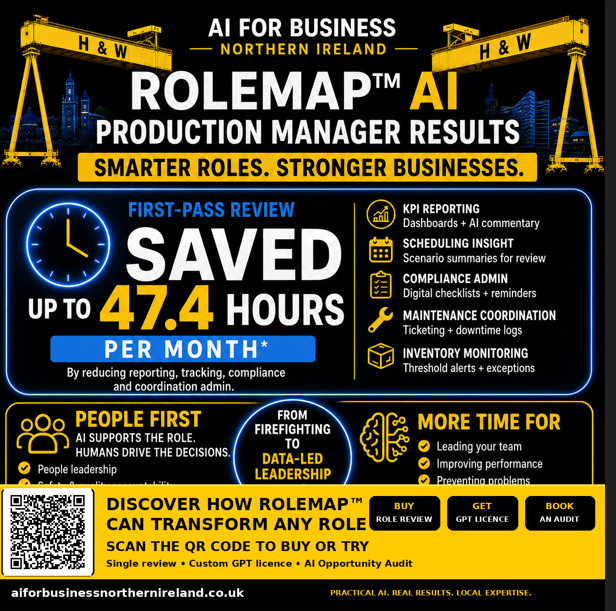
RoleMap AI helps businesses review a job description, skills matrix or task list and identify:
- tasks AI could support;
- activities that may be automated;
- possible time savings;
- tasks that should remain human-led;
- skills employees may need next;
- future role and job-description ideas.
This can help manufacturing leaders redesign work thoughtfully rather than allowing technology decisions to reshape jobs by accident.
If automation is changing the work inside a role, RoleMap AI can help leaders understand what may be supported by AI, what should remain human-led and which capabilities may become more important.
RoleMap AI: Rethink Roles, Skills and Automation with AI
The Human Work That Should Stay Human
Manufacturing AI should not remove people from decisions requiring accountability, experience, context or professional judgement.
Human leadership remains essential for:
- safety decisions;
- quality approvals;
- engineering judgement;
- employee management;
- supplier negotiations;
- customer relationships;
- ethical decisions;
- final root-cause confirmation;
- change leadership;
- continuous improvement.
The goal is not a factory where nobody has anything to do.
The goal is a factory where skilled people spend less time copying information and more time improving the operation.
Common AI Automation Mistakes to Avoid
Buying Technology Before Understanding the Process
A new platform will not fix unclear ownership, poor data or an unstable process.
Trying to Automate Everything
Some tasks are too variable, too risky or too dependent on human judgement.
Starting With the Biggest Project
A small automation with visible results can build more confidence than a major transformation programme that takes a year to deliver.
Ignoring Employees
The people completing the work usually know where the real frustrations are.
Failing to Measure Results
If nobody measures time saved, quality improved or delays reduced, the automation may become another tool with a monthly subscription.
Treating AI Output as Fact
AI can produce confident mistakes. Human review and evidence remain essential.
Automating Waste
If the process contains unnecessary steps, automation may simply make the wrong work happen faster.
AI Lean Training for Manufacturing Teams
AI Lean helps manufacturing teams connect process improvement with practical AI.
It teaches people to:
- understand the real business problem;
- map the current process;
- identify waste, duplication and delay;
- separate value-added work from unnecessary activity;
- assess whether AI or automation is appropriate;
- prioritise opportunities;
- build sensible pilots;
- measure the result.
This is particularly useful for:
- Lean practitioners;
- operational excellence teams;
- business analysts;
- transformation professionals;
- production managers;
- quality teams;
- continuous improvement leaders.
Manufacturers that want to develop these skills internally can explore the AI Lean Training Academy or arrange tailored AI Lean training for their teams.
What a Sensible First 90 Days Could Look Like
Days 1–30: Discover
- Map key processes.
- Speak with employees.
- Identify repetitive work.
- Review existing data.
- Select a small number of opportunities.
Days 31–60: Test
- Build one or two simple pilots.
- Keep human review in place.
- Train the people involved.
- Measure the current baseline.
Days 61–90: Prove
- Compare the results.
- Fix issues.
- Document controls.
- Decide whether to expand.
- Share what was learned.
This approach helps manufacturers build confidence without committing to unnecessary technology too early.
Businesses that want support moving from discovery into a practical pilot can work with AI For Business Northern Ireland to map the process, design the automation and measure whether it is delivering a real result.
Who This Is For
This approach is suitable for:
- manufacturing business owners;
- managing directors;
- operations directors;
- production managers;
- quality managers;
- engineering managers;
- health and safety managers;
- supply chain teams;
- maintenance teams;
- Lean practitioners;
- continuous improvement leaders;
- business analysts;
- HR and workforce transformation teams.
It is particularly relevant for Northern Ireland manufacturers that want to use AI but need a practical starting point grounded in safety, quality, productivity, cost and people.
A Practical Starting Point
AI in manufacturing does not need to begin with robots walking across the factory floor.
It may begin with:
- a quality report that writes its first draft automatically;
- a supplier alert that appears before the shortage causes disruption;
- a shift handover that highlights the right issues;
- a root-cause investigation that goes one question deeper;
- a maintenance record that is finally easy to find.
The best AI automation opportunities are often not the loudest.
They are the ones that quietly remove wasted time, improve visibility and help experienced people make better decisions.
That is the purpose of AI Lean.
Improve the work first.
Automate what makes sense.
Keep people in control.
Measure the result.
Manufacturers that want to identify the right starting point can book an AI Opportunity Audit with AI For Business Northern Ireland.
Teams that need a stronger root-cause approach can explore FishbotGPT. Contact us
Businesses reviewing how roles and skills may evolve can use RoleMap AI. RoleMap AI: Rethink Roles, Skills and Automation with AI
Organisations that want to develop internal capability can explore the AI Lean Training Academy, the AI Opportunity Auditor Academy or tailored manufacturing AI training.
Where the opportunity is clear, AI For Business Northern Ireland can also design and build practical automations around the systems and processes already in use.
The first step is not buying another platform.
It is understanding where the real opportunity is
Frequently Asked Questions
What is AI automation in manufacturing?
AI automation in manufacturing uses AI, workflow tools or connected systems to reduce repetitive work, organise information and support faster decisions. Examples include automated production reports, quality action tracking, maintenance summaries and supplier alerts.
What are simple AI automation opportunities for manufacturers?
Simple opportunities include meeting action tracking, daily production summaries, shift handovers, quality issue logs, supplier shortage alerts, maintenance request forms, document automation and training record reminders.
Do manufacturers need expensive AI software to get started?
No. Many useful automations can be built using existing business software, spreadsheets, forms, workflow platforms and approved AI tools. The process and business problem should be understood before technology is selected.
What is AI Lean?
AI Lean combines Lean process improvement with AI and automation. It helps businesses remove waste, simplify processes and identify where technology can create measurable value.
What is FishbotGPT?
FishbotGPT is a structured problem-solving tool designed to support deeper root-cause analysis. It helps teams move beyond surface-level explanations by asking better questions and testing possible causes against evidence.
Can AI complete root-cause analysis automatically?
AI can support the investigation, organise information and suggest questions, but experienced people must review the evidence and confirm the true root cause.
Can AI automate quality reporting?
Yes. AI and workflow automation can help collect information, summarise defects, track corrective actions and create quality reports. Final quality decisions and approvals should remain with qualified people.
Can AI help with production planning?
AI may help organise production information, highlight constraints and support scenario analysis. Any planning recommendation should be reviewed against real operational conditions.
How can we decide what to automate first?
Begin with tasks that are repetitive, time-consuming, rules-based and supported by reliable data. An AI Opportunity Audit can help assess value, risk, complexity and likely benefits
.AI Automation Discovery Audit
Can AI replace manufacturing employees?
The strongest use cases normally support employees rather than replace them. AI can reduce repetitive administration and give skilled people more time for problem-solving, quality, customer support and improvement.
What is RoleMap AI?
RoleMap AI reviews tasks, job descriptions or skills information to identify where AI could support work, what may be automated, what should remain human-led and which future skills may be required
.RoleMap AI: Rethink Roles, Skills and Automation with AI
Can our team learn how to identify AI opportunities?
Yes. The AI Opportunity Auditor Academy and tailored training can help employees, managers and improvement professionals identify, assess and prioritise practical AI and automation opportunities.
Can AI For Business Northern Ireland build these automations?
Yes. AI For Business Northern Ireland can help manufacturers identify suitable opportunities, map the current process, design practical automations and support implementation around the systems already in use.
How do we get started?
Start by reviewing the processes creating the most wasted time, delays, rework or poor visibility. You can then book an AI Opportunity Audit to prioritise the strongest opportunities and agree practical next steps.
AI Agency Belfast | AI for Business Northern Ireland